Poem: A Day in the Country

Cento (collage poem)

Source Text: The Outdoor Life of Children


a day in the country
off to lonely places
a dream of possible delights
the hot hours of the day
the vastness
the complexity
the mystery of Nature
a wild scamper
divested of garments
a spring shower is a sort of electric bath
nestling in the heather
Earth has a warm bed to offer
bodily vigour
clutches the grass
animal heat
deliciously soothed
by the cool touch of the air
the sights and sounds of the country
every one shall be delightful


Poem: The Outdoor Life of Children

The Outdoor Life of ChildrenI’ve been playing around quite a bit lately with erasure and found poetry.  Today I constructed a cento (a collage poem) made from words/phrases found in The Outdoor Life of Children by Charlotte Mason (a British educator from the last century).


The Outdoor Life of Children

A child has a natural interest in living things

Some children are born naturalists

A very prophet of nature

Communing with the larger Mother

Unbounded interest and delight

Capers about in endless ecstasy.

Drop seeds of truth into the open soul of the child

Make full use of opportunities

Watching the ways of sparrows

Infuse into them

A seed of sympathy

A love of investigation.

The sense of beauty comes from early contact with nature

A boudoir full of shells and fossils

Flowers and seaweeds

The movements of the bird, cloud, lamb, child

Unspeakable awe and delight

He is in bliss

The sad child-life from which bees and birds and flowers are shut out.

Let him work with things

Not with signs

The things of Nature in their own places

Meadow and hedgerow

Woods and shore.

Cherish in each child

Their capacity of being pleased

Children are storing up memories of a happy childhood

Every hour spent in the open air is clear gain

poem: living on the borderline


he requires you to be irrational

for if it isn’t you

then who could it be

he’s unable to chance

being out of his mind

blame is easier

than self-reflection

or personal implications

even while ceaselessly

contemplating his own reflection

you’d expect he’d perceive

the reality and truth

but the warped glass

allows only distorted forms

accessible to countless

understandings

and misinterpretations

Revision: Doing Dishes (with textual photographs)

A work in progress.  This is a revision of an earlier post: Doing Dishes.  This revision also includes a series of “textual photographs” at the end.  For those who don’t know, a textual photograph isn’t an actual photograph.  It’s a picture in your mind of something you “see,” and then you use words/text to describe your mental photograph to help the reader “see” a scene that lives only in your mind.


dishwashing (2)by Debi

Even with an automatic dishwasher, the plates, cups, pots, and pans still pile up in my kitchen.  Maybe it’s not so much that I’m a lousy housekeeper, but that I’m a distracted one?  The dishwasher needs to be emptied prior to loading in fresh dirty dishes, but emptying the dishwasher requires I stop doing whatever else I’m doing.  It also just plain seems like too much work at times.  In reality, it isn’t a lot of work when I actually do it. But my mind tends to make emptying the dishwasher seem like a huge task looming over me that will somehow disrupt my entire day, taking me away from more intriguing ways to spend my time and energy.  Before reloading the dishwasher with fresh dirty dishes, the caked-on gunk needs to be soaked for a few minutes and lightly scrubbed or the dishwasher leaves residue.  Learned this the hard way after needing to rewash too many dishes.  Found it was easier to just soak and rinse everything rather than chiseling off the baked on goo left behind after the dishwasher’s drying cycle transformed food residue into concrete.

There’s something calming, almost mesmerizing about doing dishes by hand. The mindlessly repetitive, rhythmic movements. The soothing warm water. The fragrant lemon-scented bubbles, soft and silky on tired hands.  Sometimes I listen to music while dishwashing. My favorite dishwashing CD is the soundtrack to the No Reservations movie.  Usually I listen to the soundtrack in my head.  A song stuck in my brain, quiet random ruminations, a remembered childhood poem. There is satisfaction in the transformation of the kitchen from disarray to order. Hysteria to calm. Is it less satisfying on some internal level to only do little clean-ups here and there, but never have the transformational experience that comes from a complete overhaul? Is that why I procrastinate doing dishes?

Creative moments can surprise us. But times of quiet personal reflection are often a prelude to accessing our deeper selves.  Standing at the kitchen sink, up to my elbows in warm, soapy water, gently scrubbing my plates and glassware brings on a meditative state for me.  Standing in one place, actively involved with a mindless, repetitive, physical activity, releases my creative self.  Dreaming, meditating, creating—all part of the same deep interior well.

Many things I’ve written developed after a time of quiet personal reflection—believe it or not, usually while standing at the sink up to my elbows in warm, soapy water, gently scrubbing my plates and glassware.  Standing in one place, actively involved with a mindless physical activity, seems to release something creative.

Writers over the centuries have used walking as a physical meditative process.  For me, while I thoroughly enjoy a good walk, I find myself caught up in the sights and sounds, people and birds, creatures and weather around me, and my mind isn’t quite as free to wander as it is when I’m staring at a corner and small window of my kitchen.  The kitchen almost works as a sensory deprivation chamber.  There isn’t much to see, hear, or experience.  Just the warmth, the steam, the water, the suds, the rhythms of the washing.

I wonder why I delay doing dishes when it’s often such a fruitful experience?  I have no answer.

But on that note, my dishes await.  Meditation time draws nigh.


Photograph #1

Interior of author’s kitchen. Countertops, kitchen sink, and range top are piled haphazardly with dirty dishes, silverware, pots and pans, drinking glasses, and coffee mugs.


Photograph #2

Close-up of open automatic dishwasher filled neatly with clean plates, bowls, silverware, glasses, and mugs.


Photograph #3

Full kitchen shot, showing author removing clean dishes from automatic dishwasher.  Overhead cupboard is open, revealing small stacks of plates, bowls, upside down glassware, and mugs.  Countertops above dishwasher and to the left of the author are covered with array of dirty dishes.


Photograph #4

Close-up of author’s right hand putting the No Reservations CD into a portable CD-player.


Photograph #5

Medium close-up of side-by-side stainless steel kitchen sink with approximately 12 inches of countertop visible to the left of sink.  Several stacks of dirty dishes, glassware, and a bowl of sudsy water with silverware handles protruding from bubbles are just visible on countertop.  Left-hand sink is filled with water and a generous mound of white shiny bubbles.  Steam is visible above left sink.  Right-hand sink is clean and empty except for metal dish drying rack.


Photograph #6

Long full body shot of author standing at sink with both hands dipped beneath the bubbles.  Author is seen from left side.  A beam of sunshine is coming through the small sliding window over sink, lighting the author’s long straight dark hair and face (shown in profile).  Author is dressed in faded blue jeans, a plain black short-sleeved polo shirt, and red casual slip-on shoes. Fewer dirty dishes visible on countertop.  Automatic dishwasher is open directly to the author’s right, partially full of freshly rinsed dishes.


Photograph #7

Author’s clean kitchen with sun shining through the window above the sink and lighting up the countertop and the front of the automatic dishwasher.


Literary Open Mic – Follow-up

10997989_10153297995882386_3803064406462731396_n

Aaron the Barista

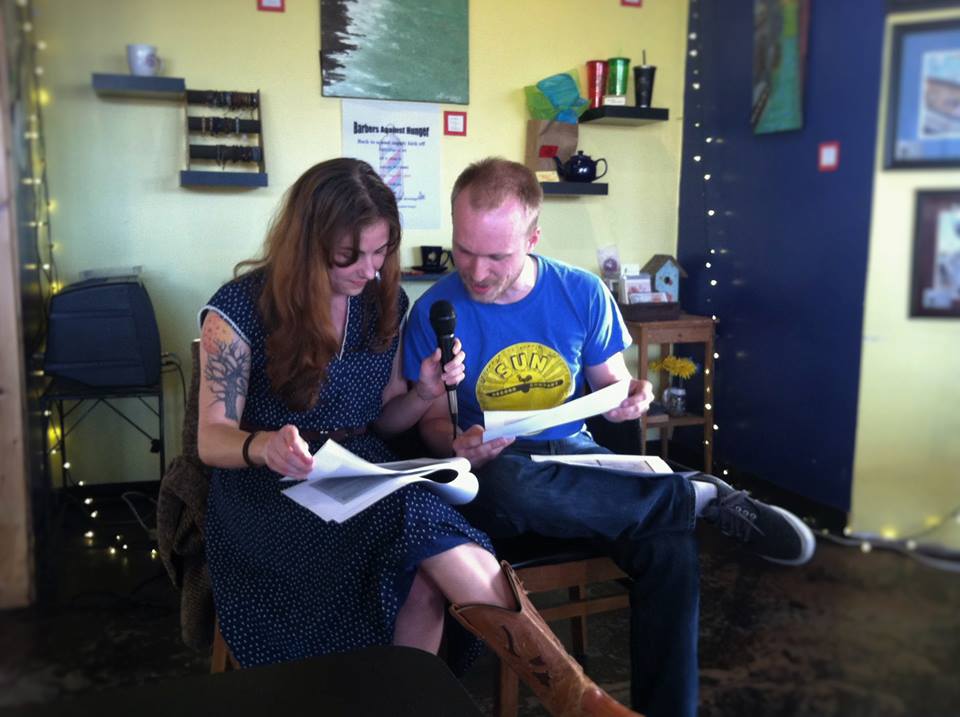
Just reporting back after a successful Open Mic event on Saturday evening at Zola’s Café in Auburn, Washington.  It was a great event and I think a good time was had by all. A number of people from the community joined us, a couple of families with children were there, and a contingent of folks from the UW Bothell 2014 Cohort drove down from the Seattle area to offer support and to read.

11196275_10153298012742386_2456440874147993333_n

Kaitlin

I thought we had a nice diversity of people in different ages and stages of life (children, parents, college students, local writers).  Even people who just happened to be at Zola’s during the Open Mic but hadn’t come to perform were inspired to participate.  I brought a selection of poetry books and anthologies for people to choose from if they didn’t want to read something they’d written.  Lewis Carroll was a popular choice–three different selections of his poetry by three different readers.

11139009_10153298013252386_3786795236282352773_n

Carol

My grandfather’s old bowler hat became the hat from which we drew names randomly for the next reader.  The general rule we followed was that each reader had five minutes to read, and could put their name back into the hat if they wanted an opportunity to read again later.  Nearly everyone who read enjoyed it enough to want to come back up a second time.  Some even did a third reading before we ran out of time.

11154859_10153298013612386_8204146176250939762_o

Tina

Before the Open Mic began, I went around to each table of customers to let them know the Open Mic was about to start and that they were welcome to listen or join in by reading a selection from a book I’d brought or maybe something they’d memorized.  Everyone was excited to be there while an event was happening, and it was fun to see them wander over to the table, browse through a book of poetry, and then write their name on a slip of paper and throw it in the hat.

11196281_10153298014842386_3059706411208503051_n

Shannon, Doug, Carol, Kaitlin

After each reader’s moment of applause (the audience was warm and accepting of everyone who shared), I would ask them briefly what their inspiration was for the poem (if it was something they’d written), or what had inspired them to read the particular one they’d chosen if it were something by another author.  The first two people were sort of taken aback slightly by my question and the need to stay up in front of the crowd after they’d finished reading, but after that, everyone seemed to understand the routine and were more than willing to share about their inspiration.

134376_10153298302397386_2026979781576340787_o

Debi, Shannon

Some shared deeply personal things about their own poetic inspiration, while some others simply said, “Because it’s a good poem. And I like it and wanted to read it.”

Even the barrista on duty read a poem called A Local Coffee Shop.

11201175_10153298016697386_5380108704869439224_n

Caroline

There was a lot of laughter, a few tears, and I felt relationships were built as people shared their poems, their art, and a bit of their hearts.  A number of people signed up to be emailed when we do it again.  The owner of Zola’s wasn’t there on Saturday night, but she dropped me a note on Monday and said that she’d heard wonderful things about the Open Mic from the people who were working that night.  She said she hopes it can become a monthly event at Zola’s.  I hope so, too.

11178293_10153298303387386_3778230539050036541_n

Tracy, Andrew

11164812_10153298017157386_6514431740705991291_n

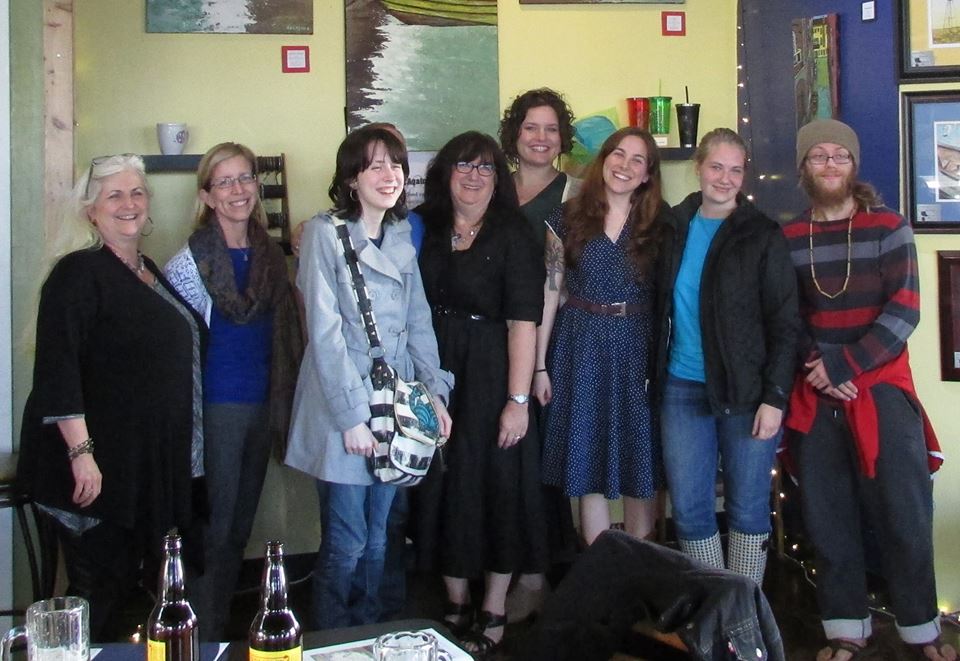
Tina, Carol, Shannon, Debi, Kaitlin, Tracy, Caroline, Nolan

Poem: Habits

Habits book cover imageI’ve been playing around a bit with erasure and found poetry lately.  Today I decided to grab a random book off my shelf (specifically not poetry) and construct a poem of sorts from words/phrases in the first few pages/chapters.

The book I chose to play with today was Habits by Charlotte Mason (a British educator from the last century).


Habits

We are all mere creatures of habit
we think our accustomed thoughts
make our usual small talk
the trivial round
the common task

The mother’s thoughts run on her children
the painter’s on pictures
the poet’s on poems

The philospher—
a thinker of high thoughts—
apt to forget that the thought that defiles
behaves precisely as the thought that purifies

The child—
born with the future in his hands—
the habits of the child
produce the character of the man
an act of faith resting on experience

The effort of decision is the greatest effort of life
not the doing of the thing
but the making up of one’s mind
which thing to do first

Experiment: Grandpa’s Trophy Room

Our instructions in class last night were to do a free write about a place or experience or item from our childhoods that was somehow powerful or incredibly important to us.  Basically doing a brief bit of non-fiction memory writing.  Then, Part Two of the experiment was to go back to the same event or situation, but this time write about it as viewed through the eyes of someone who wasn’t there or who would’ve viewed the situation differently then we did.  An interesting exercise in using memory as a seedbed for creating fictional scenarios.


BearRugHeadOpenBigNon-fiction Memory-based Free Write:

“Grandpa’s Trophy Room (with Mary)”

It was like being given the key to a magic kingdom. Entry into a dark world of bear rugs, deer heads, gun cabinets, hunting photos, and dust.  My childhood friend, Mary, and I lived for those days when we were handed the key on the large wooden key ring shaped like a fishing bobber.

The bears were the islands—the cold speckled linoleum, the lava.  “Don’t step on the lava!”  as we jumped from island to island.  Grandma always made us take our shoes off before we could play our hot lava game.  Only stocking feet were allowed on the pelts.  I can remember the feel of the stiff fur through our cotton socks, feeling much like dry grass to bare feet.  The socks had the added bonus of allowing us to skate/glide across the lava/linoleum.

Those were some of the best days at Grandma’s house.  When she gave us two little girls the key to the trophy room and allowed us uninterrupted time to give free reign to our imaginations.


Fictionalized Free Write of the Same Room:

“Grandpa’s Trophy Room (with Jody)”

This time when I went to visit Grandma, I brought my next door neighbor, Jody, with me.  I was thrilled to share my magical place with my friend.  As I opened the door to my personal cave of wonders, Jody gasped and stepped back away from the doorway.

“It’s okay, Jody.  I’ll turn on the light.”

Barely a whisper.  “Are they … are they … dead?”

“Yes, they’re dead.  They can’t hurt you.  Come on in.  It’s okay.  Really.”

I knew that creepy feeling of sensing the glass marble eyes following you around the room.  But it became clear Jody wasn’t worried about the animals possibly hurting her.

Still whispering, “Who killed them?  How did they die?”

Were those tears in her eyes?  She quietly took my offered hand and together we crossed the threshold into a world from her nightmares.  Jody stopped by the nearest deer head and lightly lay her hand on the softness of its neck just under the chin.

“It’s so … it’s so beautiful.”

She began to weep.  To cry as only a heartbroken six-year-old girl can cry.  Sobs coming from deep within her soul.

I was confused.  Then, all at once, I was shattered.  How had I—the overly sensitive child who cried over the lobsters in the tank at the gourmet grocery store—how had I become immune to the reality of death that was everywhere in the trophy room?  Coming into the room cold like she did, Jody had instantly seen what my jaded eight-year-old eyes had ceased to see.

At that moment, I knew I could never marry a hunter.  My own children would not lose their gentle sensitivities.  Whether I knew the thought as actually being marriage-related at the time is unclear, but I had the definite sense that I would not knowingly or willingly choose the hunter’s life for my future.  Whatever that future might be.

Jody never fully recovered from her initial horror of the trophy room.  She was convinced now that my silly playful grandfather was a mass murderer on par with Jack the Ripper.  A mad man hiding in plain sight in suburbia.  A den of horrors in his basement.  He even had furniture and decorative objects made from appendages of his victims, a bit like the skin suit in Silence of the Lambs. My grandfather had manufactured a gruesome cabinet of decapitated wonders.

I still played the hot lava game with Mary for a couple more years after the true nature of the trophy room was revealed that day with Jody.  But much of the magic was gone.  Now instead of losing myself in the world of pure imagination, I became a bit more adept at the practices of denial.  And some mild dissociation.  When you’re the only child in a family of heavily armed hunters, you tend to keep your sensitivities to yourself.  Survival—both physical and social—is an important instinct in the offspring of the human animal.


[FYI: The change of heart I experienced in the second piece was actually true, but taking Jody to the basement was fiction and not the cause of my inward change.]

Experiment: Textual Photographs

This experimental piece of writing is followed by a series of “textual photographs” per instructions given in class this week.


Diary Entry
October 6th, 2007

Moving into his own apartment has definitely been the best thing for him.  One of my husband’s main symptoms is an inability to deal with distractions and things being “out of order.”  Living in a household with three kids, a wife, pets, and the general happenings of any busy family was too much for him. The kids and I walked on eggshells constantly, but anything could upset him. There was no way to prevent his rages.

SLAM!
(Who knew a freezer could slam shut so loudly?)
Stomp. Stomp. Stomp.
“WHAT THE HELL? THE ICE CUBE TRAY’S HALF EMPTY AGAIN!  HOW MANY TIMES DO I HAVE TO SAY IT?—FILL THE GOD DAMN TRAY WHEN YOU USE ICE!”
More than yelling.  Roaring.  A raging lion.
Rattling windows.  Rattling nerves.
Over ice cubes?
Children and cats scamper to hiding places throughout the house.
“Honey, please.  Try to calm down.  You’re scaring the kids.”
“I’M NOT SCARING THE KIDS!  YOU’RE SCARING THE KIDS!”
Oof.  Ouch.
Wow, such a horrifying feeling—someone picking me up and throwing me physically across the room like a toy to land in a crumpled heap on the living room floor.
“WHAT THE FUCK ARE YOU DOING ON THE FLOOR?  GET UP!”
Later, he’d ask why I over-reacted and threw myself across the room.
Another day in the life of this stupid disease.

Keep in mind this was previously one of the kindest, gentlest men I’d ever known.  These rages and out-of-control episodes were completely out of character for the man I’d been married to for essentially my entire adult life. He never physically hurt the children. I spent my waking hours keeping the kids safe. But because I was constantly putting myself between him and the kids, I called down his wrath and rages directly onto myself.

He doesn’t seem to remember why we’re no longer living together.  He often forgets that he even has a problem—another prominent symptom:  lack of self-awareness.  He seems to think our marriage just ended.  It’s sad and difficult to be married to a man who no longer recognizes our relationship as an on-going thing.  Sometimes he remembers we had to separate households because of his health problems.  He’s always so sad when he remembers what’s actually happening. Other times he seems to think he’s an adult child who left home.

VOICE MESSAGE:  ‘I can’t come down this weekend.  I’m going to a birthday party. See you next weekend.’
Repeat.  We hear the same Voice Message every Thursday for three months.
“Mom, I don’t think Dad even knows enough people to have a birthday party to go to every weekend.  Do you think he even remembers from one week to the next that he’s used that excuse before for not coming down?”
“Nope, he probably has no idea he’s said it before.”
“Sometimes it feels like there’s a glitch in the Matrix. It’s such a stupid excuse, too … a little kid excuse.”
“Yeah, I know.”
“It’s super frustrating how we have to hold our weekend plans open just in case he actually has a weekend without a ‘birthday party’.”
Hugs. Tears.
“I miss my dad.  I don’t know who this guy is.  It’s like we inherited somebody’s crazy uncle. But we have to call him Dad.”

He won’t let us come to his apartment anymore.  I don’t know if it’s just the stress of having people there that’s too much for him, or if he’s hiding something.  With his memory lapses and uncontrolled rages, it’s hard to make sense of what’s happening in his life these days.

He no longer acknowledges our anniversary or my birthday.  He no longer wears his wedding ring. I’m living life as a married woman—he’s living life as a single person. In many ways, it feels like he’s already died. The kind, gentle man I’ve loved and built a life with is long gone.  Some stranger stepped in to take his place.  Could be a new episode of Invasion of the Body Snatchers.

Before he became ill, we would talk. A lot. Staying up most of the night, talking about life, family, goals, dreams, parenting, etc., was a common—almost nightly occurrence—for years and years in our marriage.  Now, when I face major (and even minor) family decisions—and I find myself wishing that I had my husband’s input—I can recall our past conversations and extrapolate from there how he may have responded to the situations now.  I find this is a helpful and practical way to honor and respect him for the man he was before this horrible disease took him from us.


Photograph #1 (November 1979)

Casual wedding photo taken in Hough’s living room.  Bride in white Gunny-Sac dress with matching wide-brimmed lace-trimmed bridal hat.  Groom in brown corduroy three piece suit.  Stone fireplace in background.  Bride and groom holding hands, looking directly at camera, and smiling.


Photograph #2 (May 1987)

Husband holding baby in front pack.  He is wearing a white and blue striped polo shirt with light blue shorts.  Photo taken on mountainside at Ohme Gardens State Park in Wenatchee, Washington.  Trees and Wenatchee Valley in background.  Baby is sleeping with head resting on her father’s chest.  He is smiling.  Had right arm cradling baby’s back.


Photograph #3  (Easter morning, 1997)

Outdoor family photograph taken before church.  Mother to the left of photo wearing knee-length off-white skirt with matching sweater, holding two-year-old daughter who is wearing a pink and blue print dress with matching floppy hat.  Father to the right wearing navy dress pants and casual button-down short-sleeved beige shirt.  He has his hands on the shoulders of ten-year-old daughter (center of photo) and six-year-old son (to the right).  Older daughter wearing a white sleeveless dress with multi-colored polka dots.  Son wearing navy dress pants, blue-and-white button down shirt, and navy bow-tie.  Everyone is smiling except for son who is frowning and staring at something out of sight behind and to the right of photographer.  Front of a small white house, green lawn, and red rhododendron in background.


Photograph #4 (November 2004)

Family trip to Disneyland.  Mother standing to the left of photo wearing black sleeveless polo, beige walking shorts, and brown leather Doc Marten sandals.  Mother has arms around shoulders of two oldest children standing on either side of her.  She is frowning and looking at husband.  Oldest daughter is between mother and father, wearing a pink Minnie Mouse t-shirt, blue shorts, and white Converse shoes.  She is not smiling and has both arms around mother’s waist, head resting on mother’s left side. Son is standing to left of mother, wearing “I’m Grumpy” Snow White themed t-shirt, frowning and looking at ground.  Youngest child smiling and standing between older sister and father, wearing one-piece sun suit, and holding hands with older sister.  Father to right of photo, frowning and looking off into distance, hands on hips, elbows wide, standing about 12-inches away from family group.  He is wearing a black Mickey Mouse t-shirt, blue shorts, white crew socks, and white running shoes.  One sock is rolled down to top of shoe, other sock is pulled up to just below the knee.


Photograph #5  (January 2005)

Outside hospital emergency room.  Mother wearing grey sweatpants and navy hoody, sitting in wheelchair, arm in sling, frowning, visible black eye.  Father wearing blue jeans, black sweatshirt, white running shoes, and pushing wheelchair, frowning.


Photograph #6 (June 2007)

Family photo taken outside home in Auburn, Washington.  Flowering cherry tree and blue house in background.  Mother in center of photo, smiling, wearing blue jeans, white button-up short-sleeved blouse, black leather sandals.  Smiling oldest daughter standing to mother’s right, wearing multi-colored floral skirt with yellow tank top.  Youngest daughter standing in front of mother and sister, wearing blue shorts, green t-shirt, white sandals, smiling and holding long-haired tabby cat.  Son standing left of mother, frowning and not looking at camera, holding skateboard in right arm.  He is wearing black jeans, black skateboarding shoes, black t-shirt, black stretchy hat, and red-green-and-white beaded necklace with black skull pendant.

Doing dishes

by Debi

In her essay, “Trouble Man,” Dodie Bellamy states, “I’m a lousy housekeeper, and by the end of the week dishes are stacked on every available surface of my kitchen.”

Me, too. Surprisingly, even with an automatic dishwasher, the plates, cups, pots, and pans still pile up.  My problem is that the dishwasher needs to be emptied prior to loading in some fresh dirty dishes.  Maybe it’s not so much that I’m a lousy housekeeper, but that I’m a lazy one?  Emptying the dishwasher just seems like too much work.  In reality, it isn’t a lot of work when I actually do it, but my mind tends to make emptying the dishwasher seem like a huge task looming over me that will somehow disrupt my entire day.

Bellamy listens to Marvin Gaye’s Trouble Man soundtrack while she’s getting caught up on the week’s backlog of dried on kitchen gunk.  Sometimes I listen to music, too—my favorite dishwashing CD is the soundtrack to the No Reservations movie.  But usually I listen to the soundtrack in my head.  Either a song stuck in my brain, or just my quiet ruminations on life.

There’s something soothing, almost mesmerizing about doing dishes. The mindlessly repetitive, rhythmic movements.  The warm water and fragrant bubbles.  It’s satisfying to take the kitchen from complete disarray, and return it to a clean, shiny state.  Is that why I procrastinate?  Is it less satisfying on some internal level to just do little clean-ups here and there, but never have the transformational experience that comes from a complete overhaul?

Many things I’ve written have developed after a time of quiet personal reflection—believe it or not, usually while standing at the sink up to my elbows in warm, soapy water, gently scrubbing my plates and glassware.  Standing in one place, actively involved with a mindless physical activity, seems to release something creative in my mind.

Many writers over the centuries have used the mindless activity of walking as a physical meditative process.  For me, while I thoroughly enjoy a good walk, I tend to get so caught up in the sights and sounds, people and birds, creatures and weather around me, that my mind isn’t quite as free to wander as it is when I’m staring at a corner and small window of my kitchen.  The kitchen almost works as a sensory deprivation chamber.  There isn’t much to see, or hear, or experience.  Just the warmth, the steam, the water, the suds, the rhythms of the washing.

I wonder why I delay doing the dishes when it’s such a fruitful, creative time for me?  I have no answer.

But on that note, I have dishes awaiting me.  Meditation time is nigh.