An Oppositional Poetics of Class


Question:

How can Toni Morrison’s concept of “othering” be applied to how social class is portrayed in literature, and using Erica Hunt’s ideas, what might an “oppositional poetics of class” look like?


Debi‘s Response:

Social narratives are usually told by the educated, dominant classes.  Who then speaks for the poor?   The poor and working-class are often marginalized and voiceless.  The rich and middle class are dominant and well voiced.  The poor lack the means and opportunities for expression of their plight and their reality.  The wealthier classes have the means and opportunities to acquire education and resources for communicating their lives and situations, while they have little—if any—real world contact with the lived realities of people in poverty.

In her essay “Notes for an Oppositional Poetics,” Erica Hunt states, “Oppositional poetics and cultures form a field of related projects which have moved beyond speculation of skepticism to a critically active stance against forms of domination.  By oppositional, I intend, generously, dissident cultures as well as ‘marginalized’ cultures, cutting across class, race and gender.”[1]

While it is true there are scholars who study social class, this is usually done by upper and middle class well-educated individuals who mean well, but view the poor as the “other” and try to ask questions to unearth the truth of living in poverty.  There is a big difference between being a member of a group and studying that same group as an outsider.  In an article on psychotherapy and the poor, the authors state:  “[P]oor and working-class men and women have important ideas … and their voices must be heard if we are to challenge classism and accurately address class issues in our work.”[2]  The we in the previous statement is applied to psychotherapists working with poor clients, but the sentence could also be applied to writers and how the poor are represented in literature, the arts, and the media.  Are we challenging classism and accurately addressing class issues in our work?  Or are we perpetuating stereotypes that continue to “other” the poor and keep them marginalized from society?  Hunt states, “there is nothing inherent in language centered projects that gives them immunity from a partiality that reproduces the controlling ideas of dominant culture.”[3]

Toni Morrison asks in Playing in the Dark, “How does literary utterance arrange itself when it tries to imagine an Africanist other?  What are the signs, the codes, the literary strategies designed to accommodate this encounter?”[4]  I would ask what are the signs, codes, and strategies of “othering” according to social class or economics status that can be seen in today’s literature?  Readers are assumed to be white and middle class, and characters are assumed to be white and middle class unless otherwise specified.  Often the poor are secondary decorative and comedic characters.  Their lives are not normalized.  They are often represented by stereotypes that few readers think to question.  Lazy.  Dirty.  Disorganized.  Welfare and food stamps abusers.  Uneducated.  Religious zealots.  Bad teeth. Immoral.  Crude.  Irresponsible.

According to Appio et al, “The doubly oppressive experience of living with hardship and being stigmatized for it is well documented in qualitative studies that explore the lived experiences of poverty … This convergence of deleterious life conditions, lack of political and social power, and associated stigmatization can be understood as part of a broader experience of classism.”[5]

People are generally believed to be poor due to decisions or actions that are their own fault, and this is often communicated in literature and the entertainment media.  Portraying in our writing the attributes of irresponsibility or lack of motivation in poor characters perpetuates these negative classist stereotypes and fail to take into account the social conditions that may create barriers to following through on appointments or other commitments.  Childcare issues, transportation difficulties, and variable work hours can all come into play in the real world lived experiences of the poor and working-class.

Are we portraying that fuller picture or are we just making our poverty stricken character late for an important appointment once again?  Do we talk down to our characters?  Do we ridicule their religious beliefs as being backward and comedic?  Or do we present their religious communities as the source of strength, motivation, and hope that larger society often fails to offer them?

Morrison says about Nancy, a character from Will Carter’s Saphirra and the Slave Girl, that “Nancy has access to no one to whom she can complain, explain, object, or from who she can seek protection.  We must accept her total lack of initiative, for there are no exits.”[6]  The poor are often in a position where there are no exits from their continual battle with poverty.  Continually fighting a losing battle could easily kill the initiative in anyone.  Do we portray our poor or working class characters as courageously fighting battles they usually never win?  Is it laziness we present?  Or resignation?

How we frame our characters and their motivations matters.  We need to be sure that we are not just resorting to portraying dangerous classist stereotypes out of our own laziness as writers.  As Hunt says at the end of her essay, “writing itself … enhances our capacity to strategically read our condition more critically and creatively in order to interrupt and to join.”[7] We need to work through our writing and our art at restoring the humanity of all marginalized people, whether that marginalization is the result of race, class, gender, or orientation.


[1] Erica Hunt, 198.

[2] Lauren Appio, Debbie-Ann Chambers, Susan Mao, “Listening to the Voices of the Poor and Disrupting the Silence About Class Issues in Psychotherapy,” Journal of Clinical Psychology: In Session, Vol. 69(2), 152 (2013)

[3] Hunt, 204.

[4] Toni Morrison, Playing in the Dark, p. 16.

[5] Appio, 153.

[6] Morrison, 24.

[7] Hunt, 212.

The ABC’s of Harryette Mullen

The ABC’s of Harryettte Mullen
Excerpts from quotes, interviews, articles, and reviews (collected by Debi)

A is for Academic –

“Some people think of me as an ‘academic poet,’ simply because I teach in a university, but of course I was writing poetry and interacting with diverse communities of poets before I went to graduate school. One of my struggles as a graduate student, who had already published one book of poetry, was to keep intact my identity as a creative writer while I was learning to be a literary and cultural critic, a literature teacher, a member of the academic community.”

Continue reading

Writing Experiment: The Walks

by Debi

I think I’m finally semi-happy with my latest “experiments” for one of my classes this quarter: A daily walk through local parks taking photos as I go, inspired by Sixty Morning Walks by Andy Fitch and photographic walks taken by sculptor/photographer Richard Long.

My contraints for this current experiment have been:

  1. I must walk in a different park within the Auburn city limits each time
  2. I must document the course of the walk with photos (ideally with semi-appealing photos)
  3. I can only take photos with my cell phone’s camera (and it’s a super crappy camera so this is a HUGE constraint!)
  4. I need to walk for at least half an hour (but no longer than an hour)
  5. I need to pay close attention during my walk and try to remember what I saw, felt, heard, thought … and then to write about it after returning home
  6. Post it on my blog with text and photos

On the first day’s walk, I took too many photos in general, and also too many photos that all ended up looking the same. Trees and the river. Bushes and the river. Trees and a pond.

So the 2nd day I tried to limit myself more to things I thought were unique and interesting (in almost an architectural sense). Forms, lines, sculpture-ish things.

I also realized after fiddling around for awhile, that I prefer the photos from the walks to be in black-and-white rather than color. Adds to the sculptural feeling a little bit, I think.

And surprisingly, I find it’s really difficult for me to write in sentence fragments.  My original plan was to make lists and write simple phrases.  Things ended up wordier than I’d planned. Also, I hadn’t realized how reflective I’d end up being about earlier days at these same places with my kiddos.  A modern day series of walks became a semi-memoir.

Looking forward to being able to ask questions of Andy Fitch on Tuesday night about his process writing Sixty Morning Walks.  He’ll be coming into our class to talk about his books and his writing.  Before I had actually tried doing my own “walks” and writing about them, I didn’t realize I would have any questions for him.  Now I have so many, it’ll be difficult to know where to start.

Not sure how many walks I’m going to do.  The original plan was Week of Walks, but the whole process has ended up being more time-consuming than I’d originally planned for, and I still have other homework that needs to be done.  Oh, and I have a life, too.  I don’t just study and walk.  🙂

Poem: The Lie

by Debi

This quarter in the MFA program, we’re investigating more unusual writing styles and methods.  Each week in our Writing Workshop, we’ll need to bring in an “experiment” we wrote or created during the week.  These experiments are truly experimental.  We have to write in a style or format that we’re not comfortable with and have never used before.  This should prove interesting.

The following is an experimental free-form prose poem I wrote after reading Gertrude Stein’s book of poetry, Tender Buttons, and re-reading Sir Walter Raleigh’s classic poem, “The Lie.”  My apologies to both.  😉


THE LIE

LYING, a hateful experience. And not.

I like lyres. I dislike liars. I don’t not dislike lying.

Quaint seaside bungalows lie along the coast. The lie of the golf ball makes an easy shot. The plain lies stretched out before us. We sprinkle lye upon the dead. Lying abed, lying down, lying low, lying with. Lying, a need in illness. A help with rest. A pseudonym for copulation.

Take it lying down. The decision lies with him.

Horizontal. Recumbent. Prostrate. Flat. Deception. Falsification. Imposture. Fib. Fibbing, flitting, flirting, fighting, lighting, lighten, lion, lie on. I think she’s lying through her teeth instead of flossing.  Lying in ambush. Lying in state. Lying in later so morning can wait.


Reflections after Fall Quarter in the MFA program

by Debi

While always believing that writing can be a means of healing, I find myself learning this lesson afresh in the early stages of the MFA in Creative Writing and Poetics graduate program at the University of Washington Bothell.  The writing prompts given in class have nudged me into looking at aspects of my life which I’d been ignoring and not wanting to talk about.  Ever.

I’m also reminded of the complexity of each person’s life.  Someone can grow up in a wealthy suburb like Bellevue and not be wealthy or a snobby suburbanite.  A person can have warm family memories and have recollections of abuse side-by-side in the same life.  In many ways, I think I’m developing a poetic of self.

On a somewhat egocentric track, there’s something appealing about the thought of words and ideas living on after I’m gone, maybe to be discovered anew in the back recesses of a bookshelf in some unknown future.  Writing has the potential to change an instant into an eternity, a moment into something monumental.

Ideas, art, and writing can live on after we die.  For example, Mary Shelley’s “hideous progeny,” Frankenstein, has probably affected more people in more places throughout more generations than any natural born children would have ever produced.  Any given author may die, but their words can live on, animated by the ideas of the dead author–yet inanimate, too, with no breath, no heartbeat.  Almost a zombie-life.

At the 2014 Fall Convergence which began the Fall Quarter, Canadian author Gail Scott talked about wanting to recreate the cadence of Montreal speech in her book, The Obituary, by blending together both English and French, thus creating an almost musical score from the words.  Cia Rinne’s work also produced a similar sense of musicality in the written and spoken words.  Ronaldo Wilson said at one point during the Convergence that he wishes to “sing in tune with the many songs I come from.”

And I realized, so do I.

As a parent, I have spent many warm evenings cuddled up with my children, reading aloud from classic stories.  The books we shared came alive in the reading.  The characters became our friends.  The plots felt like part of our histories. The fact that I was reading aloud gave us opportunity to listen to the writing, to feel the rhythm of the words, to hear the refrain of that dear little engine as he chugged up the hill to the reprise: “I think I can, I think I can, I think I can.”

I want my writing to be something that can be read aloud.  I want to find ways to express the musical cadence of speech of characters in a story or people in a memory. And like Ronaldo Wilson, I want to learn to make my writing sing in tune to the many songs I come from.

One of my personal goals while starting the MFA program was to discover (or rediscover) my creative writing voice.  After years of academic writing and writing for popular non-fiction venues, giving voice to my inner self has become somewhat lost, blurred, or buried.  I believe it’s time to find that voice.  Whether this means I rediscover my former writing voice, or find a new voice all together, is yet to be seen.

Wordle: UWB MFA

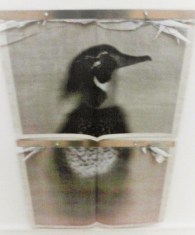
Reading aloud to a photo of a dead bird

0108151647 (2)

by Debi

On Thursday night last week, my MFA cohort had a field trip.  We met at The Henry Art Gallery on the University of Washington campus and participated as reader/scribes in the gallery-wide display, “the common S E N S E“, by American artist, Ann Hamilton.

The description of the exhibit on the gallery’s website says:

Aristotle wrote in Historia Animalum and De Anima that “touch” is the sense common to all animal species. In this project, touch is not only physical contact but a form of intellectual and emotional recognition. The exhibition is full of images and skins of animals: once alive, they touched and were touched in return by the world they inhabited. For Hamilton the common S E N S E is “an address to the finitude and threatened extinctions we share across species—a lacrimosa, an elegy, for a future being lost.”

So, back to my class field trip.

“You’re going to do what?  What exactly is a reader/scribe?”

Glad you asked.

As part of the “experience” Ann Hamilton devised, she had a set of instructions for people to come in and read aloud to artifacts in the museum.   We each were given a small bench, a soft blanket, a clipboard, a notebook, a pencil, a reading light, and a copy of J. A. Baker’s book, The Peregrine, and sent off to find an artifact we felt drawn to in some way, and then to sit down by it and read to it.  Aloud.  Like reading a bedtime story to a small child.

The gallery is a large multi-floored building, so the dozen-plus of us from class were scattered all over, reading softly to our chosen “friends.”  Some of us read to children’s books.  Some read to Alaskan clothing.  Some read to fur coats. Some read to metal poles.  I sat in front of a wall on my little stool, and read to a piece of newsprint containing a scanned image of an actual dead bird from the University of Washington’s natural history collections.

Honestly, sometimes the art world is a bit too artsy for me.  Too conceptual.  Sometimes even just plain strange.  This whole reader/scribe thing felt like it might prove to be one of “those” times.

When I arrived at the gallery, nobody else was there yet.  Traffic had been surprisingly free-flowing and parking was easy.  So I spent about forty minutes touring the exhibit as just a visitor to the museum and not as an MFA student or a reader/scribe.  I picked up all the hand-outs, followed all the instructions, and took my time wandering through the exhibits.

There was something a bit other-worldly about the exhibit.  Everything was so quiet.  The displayed items in the first couple of rooms consisted of animal pelts, birds, pieces of paper with random quotes about the sense of touch, and a variety of children’s books and primers featuring the story about the death of cock robin.

I felt a connection between the passages about touch and the death-themed displays.  The common sense between all creatures is sometimes considered to be the sense of touch.  The dead birds and small mammals on display at one time felt touch.  Now their dead bodies could be touched.  But not by us.  They were displayed in solid glass cases.  No touching allowed.  Ironic.

0108151914Stepping into the main gallery spaces, there were sheets and sheets of newsprint with scanned images of dead birds, small mammals, and amphibians.  Something about the scanned images looked like images you might see in a morgue.  The only sound was the gentle rustling of the newsprint pages in the slight breeze in the room and the soft footsteps of the visitors.  I found myself wondering what it would be like to be reading aloud in one of these silent rooms.

Reading bedtime stories to dead things.  Hm.  Death.  Sleep.  A melancholy settled over me as I went downstairs to see the other exhibits.

I walked into a room that was confusing at first.  Nothing but display boxes randomly placed throughout the room and shrouded with light-colored curtains.  When I separated the curtains to see inside the display boxes, I discovered each box contained a piece of clothing made from animal skins or fur.  One item was a raincoat made from dried and decorated intestines.  There were fur coats like my grandmother would’ve worn going out dancing in the city during the late 1920’s.  There were mukluks and parkas from native Alaskans.

The display boxes with the curtain shrouds were called “bassinets” by the artist.  Shrouded bassinets.  Containing dead animals.  And we were going to read aloud to these artifacts.

The book we read?  Well, The Peregrine is about a man who followed the lives of some peregrine falcons throughout the year.  The book told in great detail of how these birds of prey lived, how they hunted, and how they killed their prey.

0108151648Fast forward to all of us being given our reader/scribe implements and dispersing throughout the gallery to read to our chosen artifact.  I chose a scanned image of a dead woodpecker.  I found there was something disturbing about reading a “bedtime story” about a bird of prey killing birds much like my woodpecker.  I almost felt like I wanted to apologize for disturbing its rest when I’d find a particularly graphic hunting section.

I am not a hunter, myself, but I was raised in a family of hunters.  I grew up with a strong aversion to the idea of killing for sport, but at the same time spent my childhood summers at my grandparents home in the mountains surrounded by deer trophies, bear rugs, and hunting photographs of my assorted family members posing with their latest kill.

Ann Hamilton’s display at The Henry was poignant, pointed, melancholy, gentle, lovely, disturbing, sad, thought-provoking, and restful.  Yes, all of those things.  And participating as a reader/scribe was an interesting experience, too.  We will be returning to The Henry and revisiting our reader/scribe activity once more at the end of the quarter.  I wonder how it will differ after having done it once before?

I would also like to experience the exhibit at some point when there are other reader/scribes actually participating.  No one was reading when I went through the exhibit for myself, and then when my class was reading, I was reading, too, so I don’t know what it would have been like to come across random people reading a book to a museum artifact.

Does it seem sort of crazy?  It felt sort of crazy.  And sort of sane, too.

Art.  It touches me.

And so we’ve come full circle.  Touch.

The common S E N S E .